Exploit for CVE-2021-40449 - Win32k Elevation of Privilege Vulnerability (LPE)# CallbackHell
Exploit for CVE-2021-40449 (Win32k - LPE)
- [CallbackHell](#callbackhell)
- [Description](#description)
- [Technical Writeup](#technical-writeup)
- [PoC](#poc)
- [References](#references)
## Description
CVE-2021-40449 is a use-after-free in Win32k that allows for local privilege escalation.
The vulnerability was found in the wild by [Kaspersky](https://www.kaspersky.com/blog/mysterysnail-cve-2021-40449/42448/).
The discovered exploit was written to support the following Windows products:
- Microsoft Windows Vista
- Microsoft Windows 7
- Microsoft Windows 8
- Microsoft Windows 8.1
- Microsoft Windows Server 2008
- Microsoft Windows Server 2008 R2
- Microsoft Windows Server 2012
- Microsoft Windows Server 2012 R2
- Microsoft Windows 10 (build 14393)
- Microsoft Windows Server 2016 (build 14393)
- Microsoft Windows 10 (build 17763)
- Microsoft Windows Server 2019 (build 17763)
However, this exploit is current only tested on the following versions:
- Microsoft Windows 10 (build 14393)
- Microsoft Windows 10 (build 17763)
## Technical Writeup
I highly recommend reading Kaspersky's [technical writeup](https://securelist.com/mysterysnail-attacks-with-windows-zero-day/104509/) before proceeding.
As mentioned in the technical writeup by Kasperky, the vulnerability exists in `GreResetDCInternal`. If an attacker hooks the user-mode callback `DrvEnablePDEV`, which is called during `hdcOpenDCW`, it is possible to destroy the original device context by calling `ResetDC`, which causes a use-after-free in the kernel when the user-mode callback returns.
The following pseudo-code is made partially from the leaked Windows XP source code and by reverse-engineering the latest (before the patch) `GreResetDCInternal` from `Win32kfull.sys`. The irrelevant parts have been removed with `[...]`. Look for the `VULN: ` comments.
```c
BOOL GreResetDCInternal(
HDC hdc,
DEVMODEW *pdmw,
BOOL *pbBanding,
DRIVER_INFO_2W *pDriverInfo2,
PVOID ppUMdhpdev)
{
// [...]
HDC hdcNew;
{
// Create DCOBJ from HDC
DCOBJ dco(hdc);
if (!dco.bValid())
{
SAVE_ERROR_CODE(ERROR_INVALID_HANDLE);
}
else
{
// Create DEVOBJ from `dco`
PDEVOBJ po(dco.hdev());
// [...]
// Create the new DC
// VULN: Can result in a usermode callback that destroys old DC, which
// invalidates `dco` and `po`
hdcNew = hdcOpenDCW(L"",
pdmw,
DCTYPE_DIRECT,
po.hSpooler,
prton,
pDriverInfo2,
ppUMdhpdev);
if (hdcNew)
{
po->hSpooler = NULL;
DCOBJ dcoNew(hdcNew);
if (!dcoNew.bValid())
{
SAVE_ERROR_CODE(ERROR_INVALID_HANDLE);
}
else
{
// Transfer any remote fonts
dcoNew->pPFFList = dco->pPFFList;
dco->pPFFList = NULL;
// Transfer any color transform
dcoNew->pCXFList = dco->pCXFList;
dco->pCXFList = NULL;
PDEVOBJ poNew((HDEV)dcoNew.pdc->ppdev());
// Let the driver know
// VULN: Method is taken from old (possibly destroyed) `po`
PFN_DrvResetPDEV rfn = po->ppfn[INDEX_DrvResetPDEV];
if (rfn != NULL)
{
(*rfn)(po->dhpdev, poNew->dhpdev);
}
// [...]
}
}
}
}
// Destroy old DC
// [...]
}
```
As can be seen from the pseudo-code, the old device context can be freed in a user-mode callback from the `hdcOpenDCW` call, and later on, the method `DrvResetPDEV` is retrieved from the old device context and called with `(po->dhpdev, poNew->dhpdev)`.
To create and hook a device context, one can do the following:
- Find an available printer with `EnumPrinters`
- Load the printer driver into memory with `OpenPrinter`, `GetPrinterDriver` and `LoadLibraryExA`
- Get the printer driver's user-mode callback table with `GetProcAddress` and `DrvEnableDriver`
- Unprotect the printer driver's user-mode callback table with `VirtualProtect`
- Overwrite the printer driver's desired user-mode callback table entries
- Create a device context for the printer with `CreateDC(NULL, printerName, NULL, NULL)`
We should now have a device context for a printer with hooked user-mode callbacks.
We're interested in only one hook, namely `DrvEnablePDEV`. This hook is interesting in two aspects: triggering the UAF and controlling the arguments, as described earlier. To trigger the UAF vulnerability, we will call `ResetDC` inside of the hook, which will destroy the old device context. When we return from the hook, we will still be inside the first `GreResetDCInternal`, which will shortly after get and call the function pointer for `DrvResetPDEV` from our old and destroyed device context with the two arguments that got returned from `DrvEnablePDEV`; the old and the new `DHPDEV`.
If your process is running with a medium integrity level, KASLR should not be an issue with the help of `EnumDeviceDrivers` and `NtQuerySystemInformation`.
Kaspersky mentions that the original exploit used GDI palette objects and a single kernel function call to achieve arbitrary memory read/write. This exploit uses [a technique to allocate a BitMapHeader on the big pool](https://blahcat.github.io/2019/03/17/small-dumps-in-the-big-pool/) and `RtlSetAllBits` to enable all privileges on our current process token. The `BitMapHeader` will point to our current process token's `_SEP_TOKEN_PRIVILEGES`. By calling `RtlSetAllBits(BitMapHeader)`, it's possible to enable all privileges for our current process token with a single kernel function call. From here, one can abuse the new privileges to get SYSTEM. This exploit uses `SeDebugPrivilege` to inject shellcode into the `winlogon.exe` process.
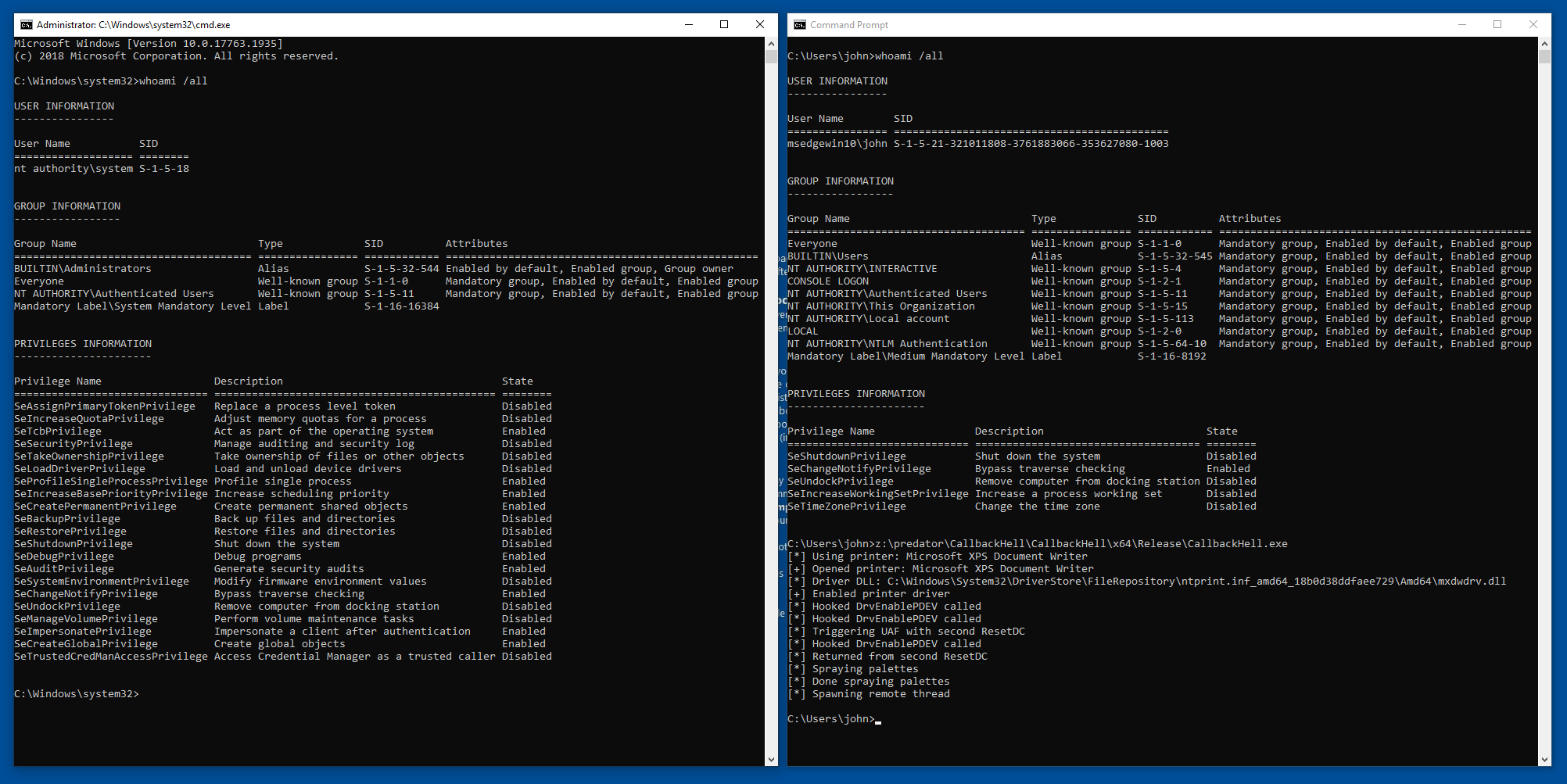
## PoC
## References
- [https://securelist.com/mysterysnail-attacks-with-windows-zero-day/104509/](https://securelist.com/mysterysnail-attacks-with-windows-zero-day/104509/)
- [https://github.com/siberas/CVE-2016-3309_Reloaded/](https://github.com/siberas/CVE-2016-3309_Reloaded/)
- [https://www.ired.team/miscellaneous-reversing-forensics/windows-kernel-internals/how-kernel-exploits-abuse-tokens-for-privilege-escalation](https://www.ired.team/miscellaneous-reversing-forensics/windows-kernel-internals/how-kernel-exploits-abuse-tokens-for-privilege-escalation)
- [https://github.com/KaLendsi/CVE-2021-40449-Exploit](https://github.com/KaLendsi/CVE-2021-40449-Exploit)
- [https://mp.weixin.qq.com/s/AcFS0Yn9SDuYxFnzbBqhkQ](https://mp.weixin.qq.com/s/AcFS0Yn9SDuYxFnzbBqhkQ)
登录后查看神龙缓存的 POC 文件快照
登录查看